
How Sleep Affects Trading Performance (And What to Track)
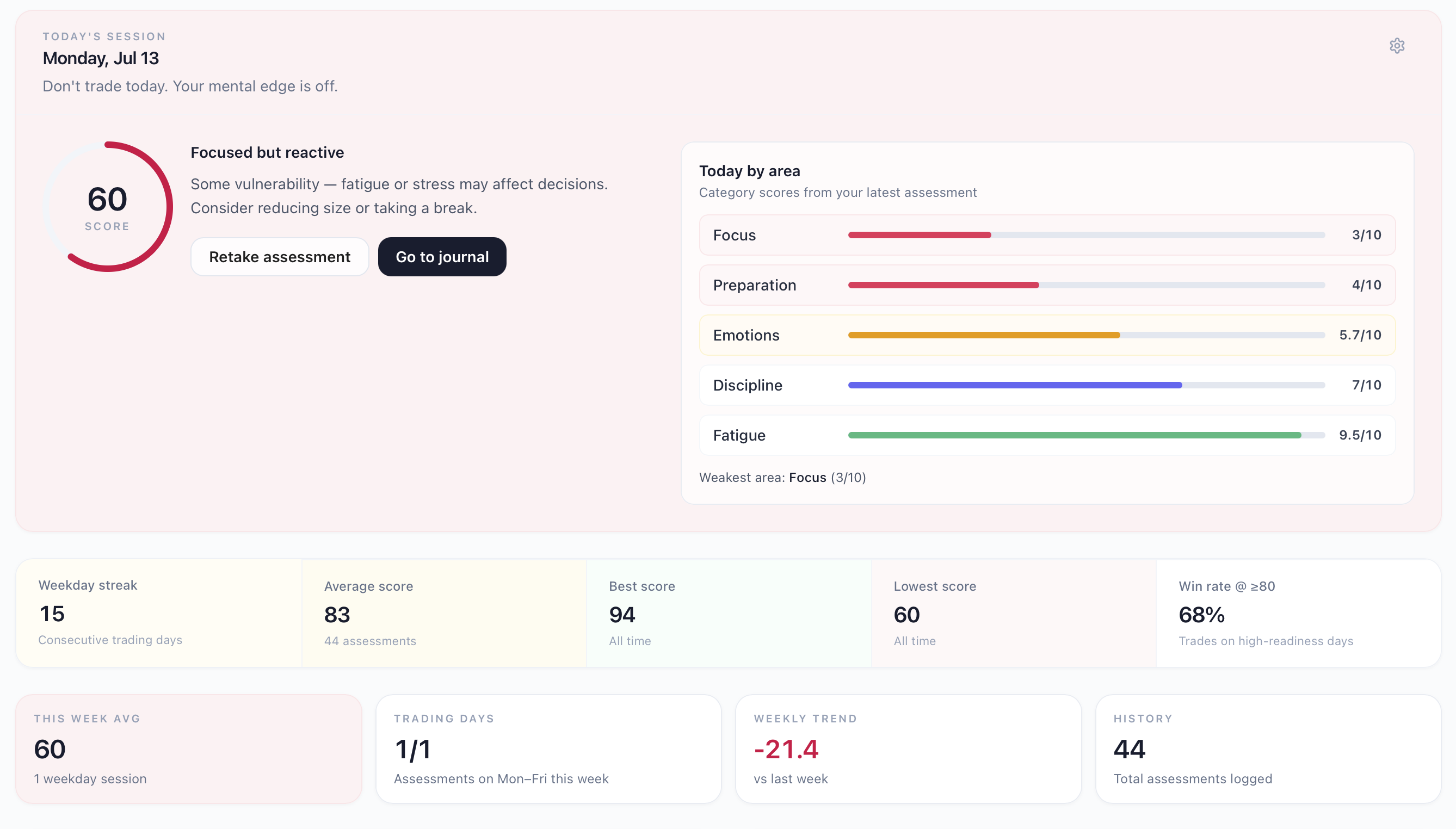
If you had to guess the single biggest predictor of a bad trading session, most people would point to the market itself. Volatility, unexpected news, a choppy open. In practice, one of the strongest predictors sits much closer to home: how well you slept the night before.
The mechanism behind it
Sleep deprivation affects the prefrontal cortex first, the part of the brain responsible for weighing risk, controlling impulses, and sticking to a plan under pressure. Even a single night of poor sleep measurably reduces impulse control and increases emotional reactivity. For a trader, that translates directly into earlier exits driven by discomfort, later entries driven by hesitation, and a general tendency to react to price movement instead of following a plan.
None of this requires extreme sleep deprivation to show up. Even losing an hour or two below your normal baseline is enough to shift decision making in a measurable way.
What tired trading actually looks like
Traders running on poor sleep tend to show a specific pattern. They oversize positions more often, because risk feels smaller than it actually is when the brain is fatigued. They exit winning trades too early out of a vague discomfort with holding the position. They also tend to chase moves they've already missed, because patience requires more mental energy than a tired brain has available.
Individually these look like ordinary trading mistakes. Traced back consistently, they often line up with the nights of worst sleep.
What to actually track
You don't need a sleep lab to start seeing this pattern. Three simple metrics logged each morning are enough to get real signal: total hours slept, a rough quality rating on a simple scale, since six hours of solid sleep often beats eight hours of restless sleep, and how alert you feel right now, separate from how many hours the tracker says you got. Log these before you look at any charts, so the number isn't influenced by how the market is already moving.
Connecting sleep data to your results
The real value only appears once you compare this against your actual trading outcomes over several weeks. Most traders who do this find a clear pattern: their largest losses and most rule-breaking sessions cluster heavily around their worst sleep nights, far more than chance would explain.
Once that pattern is visible, the decision becomes simple. On low sleep days, reduce position size, tighten your rules further, or consider sitting out entirely. That's a much easier call to make with data in front of you than it is to make in the moment, when a tired brain is precisely the one trying to convince you that today's different. A trading mindset tracker makes this comparison much easier over time.
Building the habit
Track this at the same time every morning, before the market opens, so it becomes routine rather than an afterthought. Consistency here matters more than precision. A rough daily number tracked every day beats a perfectly detailed log kept for only a week.
MentalBro includes sleep as one of the core inputs to your daily Psych Score, and automatically lines it up against your trading results, so the connection between last night's sleep and today's decisions shows up clearly instead of staying buried in memory. Use a pre-trade mental checklist on low-sleep mornings to catch risky sessions before they start, and keep the results in a psychology-focused trading journal so the pattern is there to review later.
If you have never tracked sleep alongside your trades before, this is one of the simplest habits to start with, and often one of the most revealing.
Related reading
Curious what your own sleep and performance pattern looks like?
Get your first Psych Score with MentalBro today.
Get your first Psych ScoreShare this article
Help other traders master their psychology