
Trading psychology, made measurable
Trading Psychology Journal Built for Execution
MentalBro records what happened around each decision, not only the result. Readiness before the session, mindset while the position is open, rule breaks as they occur, and execution quality after the exit — stored next to your trades so the patterns behind your P&L become reviewable.
7-day free trial, then $15/month. Cancel anytime.
The definition
What is a trading psychology journal?
A standard trading journal records what happened: instrument, entry, exit, size, result. That record is necessary, and on its own it explains very little. It tells you the outcome of a decision without telling you anything about the decision.
A psychology-focused journal adds the surrounding conditions and the behavior. It captures the state you were in before the session, what you did while the trade was live, which of your rules held, and how well you executed independently of whether the trade paid.
- Mental readiness before the open
- Emotions during the session
- Discipline under pressure
- Rule adherence, counted
- Execution quality
- In-trade behavior
- Post-trade reflection
- Patterns across months
The measurement problem
Why P&L alone isn't enough
Outcome and execution are different measurements, and in the short run they come apart constantly.
Broke every rule
+$500
Oversized, moved the stop, traded past the session cutoff, and the market cooperated anyway. The account is up. The process that produced it will not survive repetition.
Executed the plan
-$200
Correct size, stop honored, exited where the plan said. The setup did not work. The account is down and nothing needs fixing.
Judged on result alone, the first day looks like the one to repeat. A journal that records process alongside outcome lets you separate the two and review the behavior on its own terms. This is about making your own execution visible over time — not a claim about future returns.
Inside MentalBro
How the workflow fits a trading day
Each stage captures something the next stage cannot recover. On an active day the full loop takes roughly 8–12 minutes.
Before the trade
Establish the starting state so you know whether the session deserves normal risk.
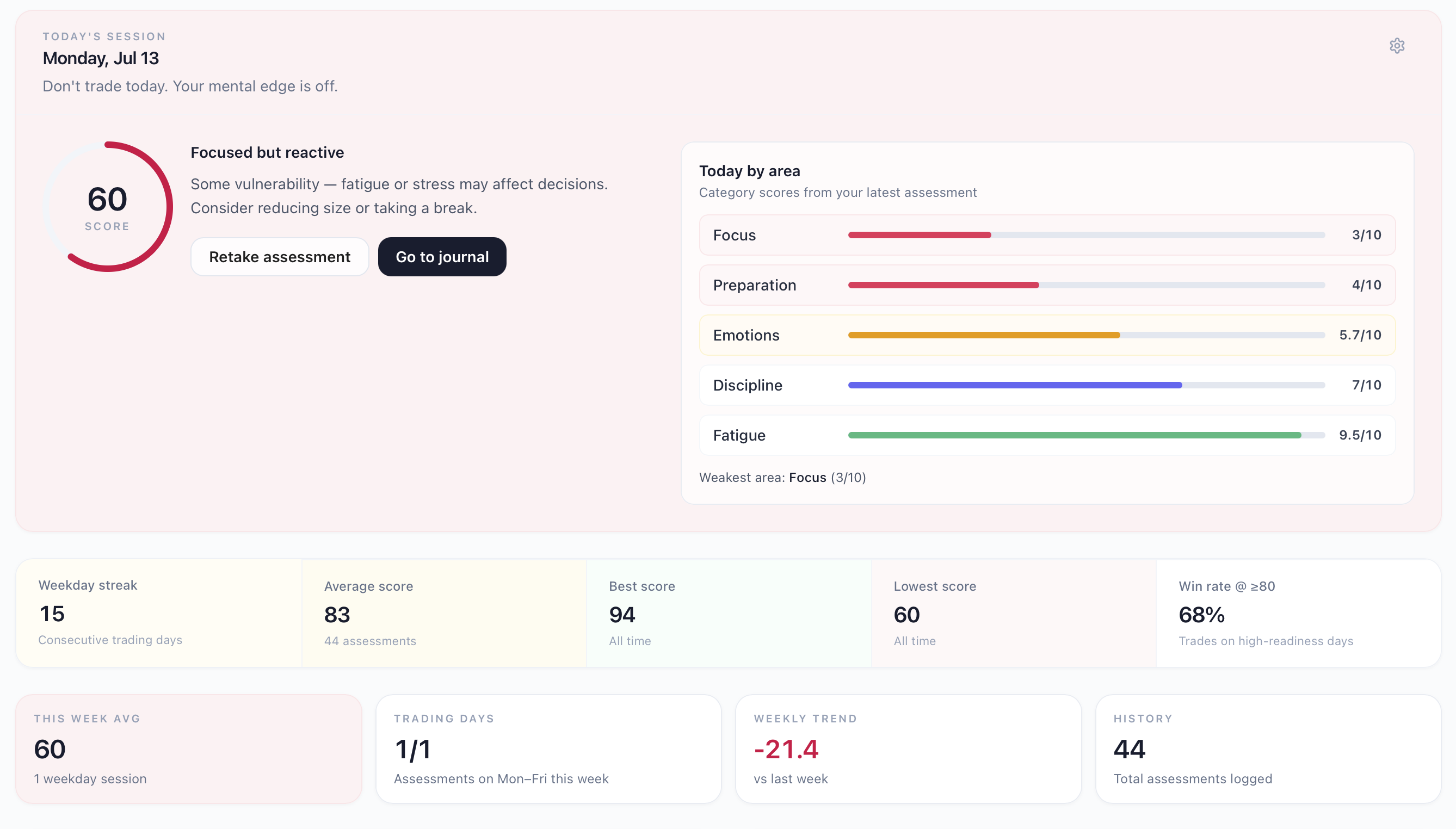
Mental Readiness Assessment
Ten questions on focus, emotions, preparation, fatigue and discipline, scored into one readiness number.
Pre-Trade Checklist
A configurable check that runs before entry so setup and risk conditions are confirmed, not assumed.
During the trade
Capture mindset while the position is open, when the behavior actually happens.
In-Trade Mindset Logs
Short check-ins that record what you were thinking and feeling while the trade was live.
After the trade
Record the result and grade the execution separately, before hindsight rewrites the reasoning.
After-Trade Assessment
A short reflection on how the trade was executed and whether you are in shape to continue.
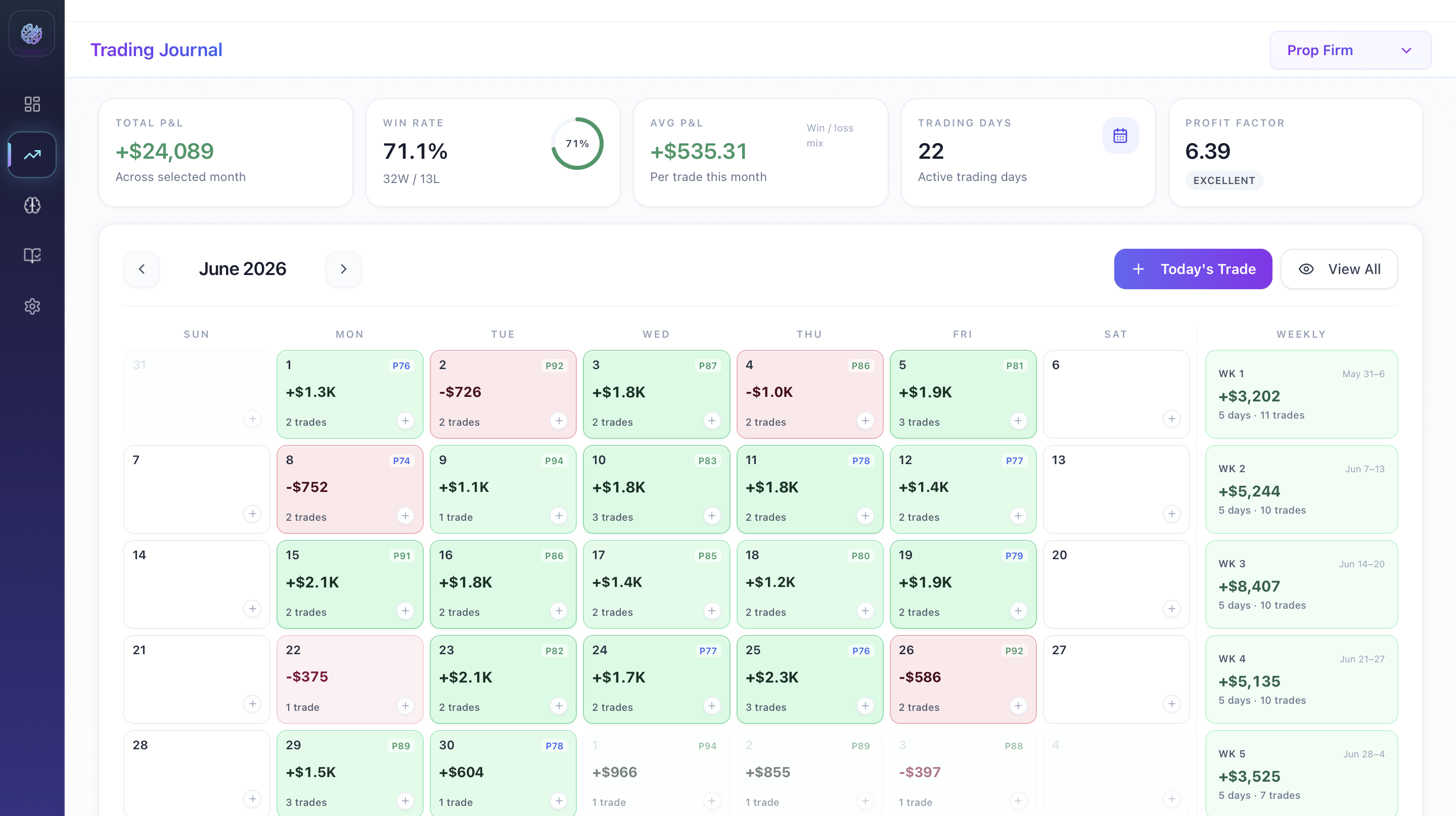
Trading Journal
Full trade log with setup, screenshots, emotion and decision context. CSV import brings in existing history.
Over time
Single sessions are noise. Patterns only appear once there are enough of them to compare.
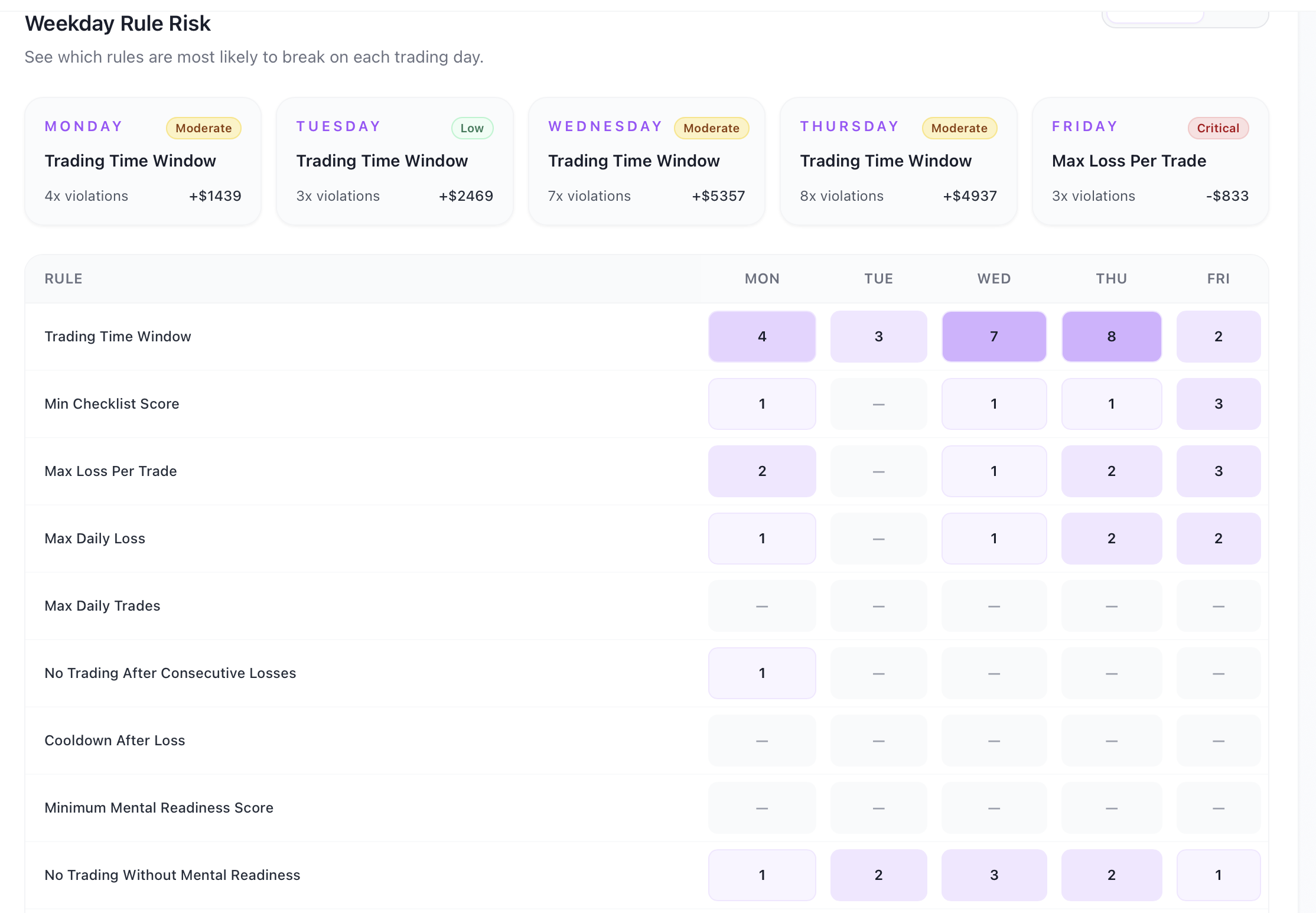
Rule Tracker
Your defined limits with violation detection, so broken rules become counted data instead of memory.
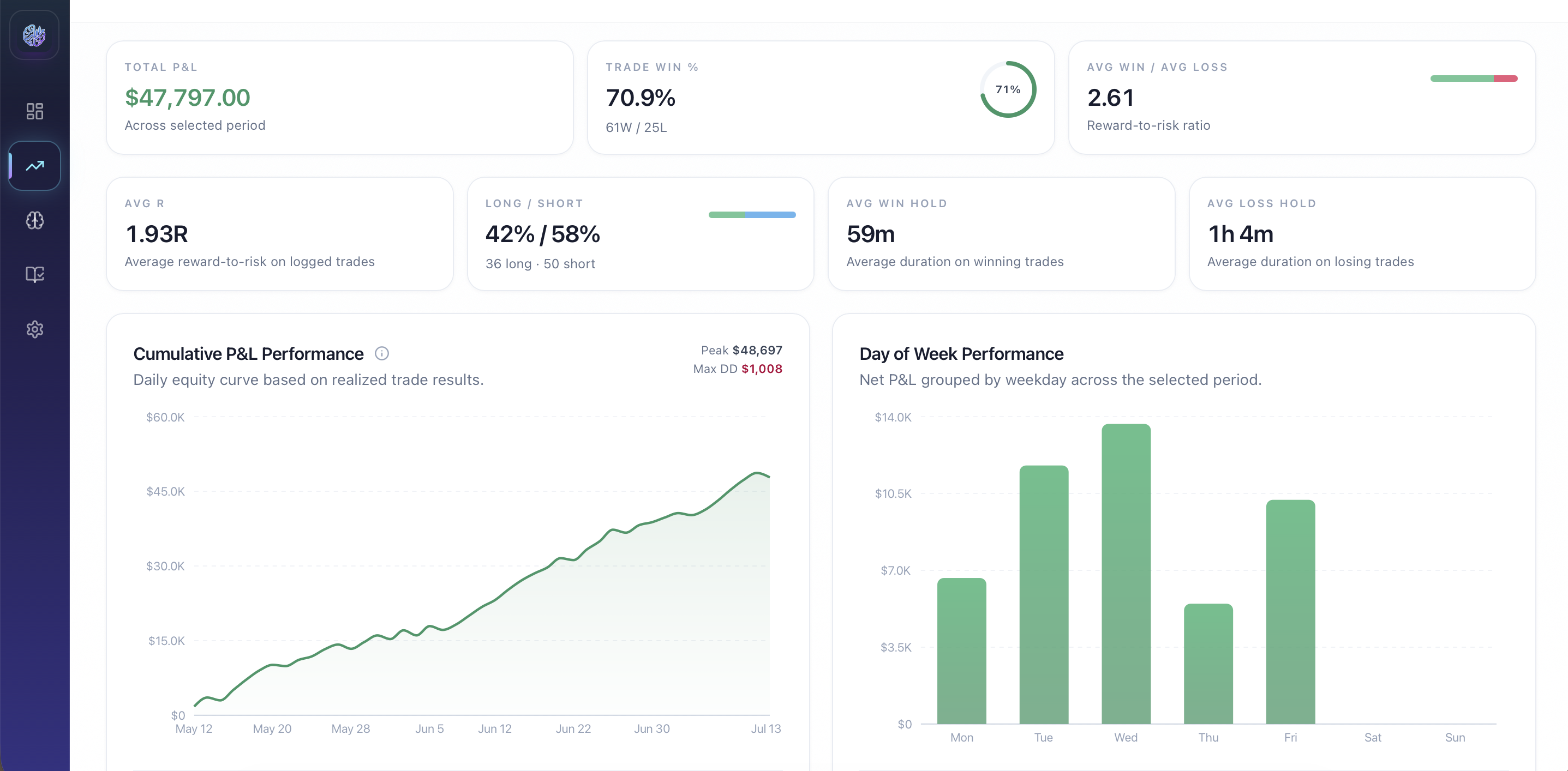
Psychology and P&L Analytics
Readiness, emotions and discipline compared against your recorded trading results.
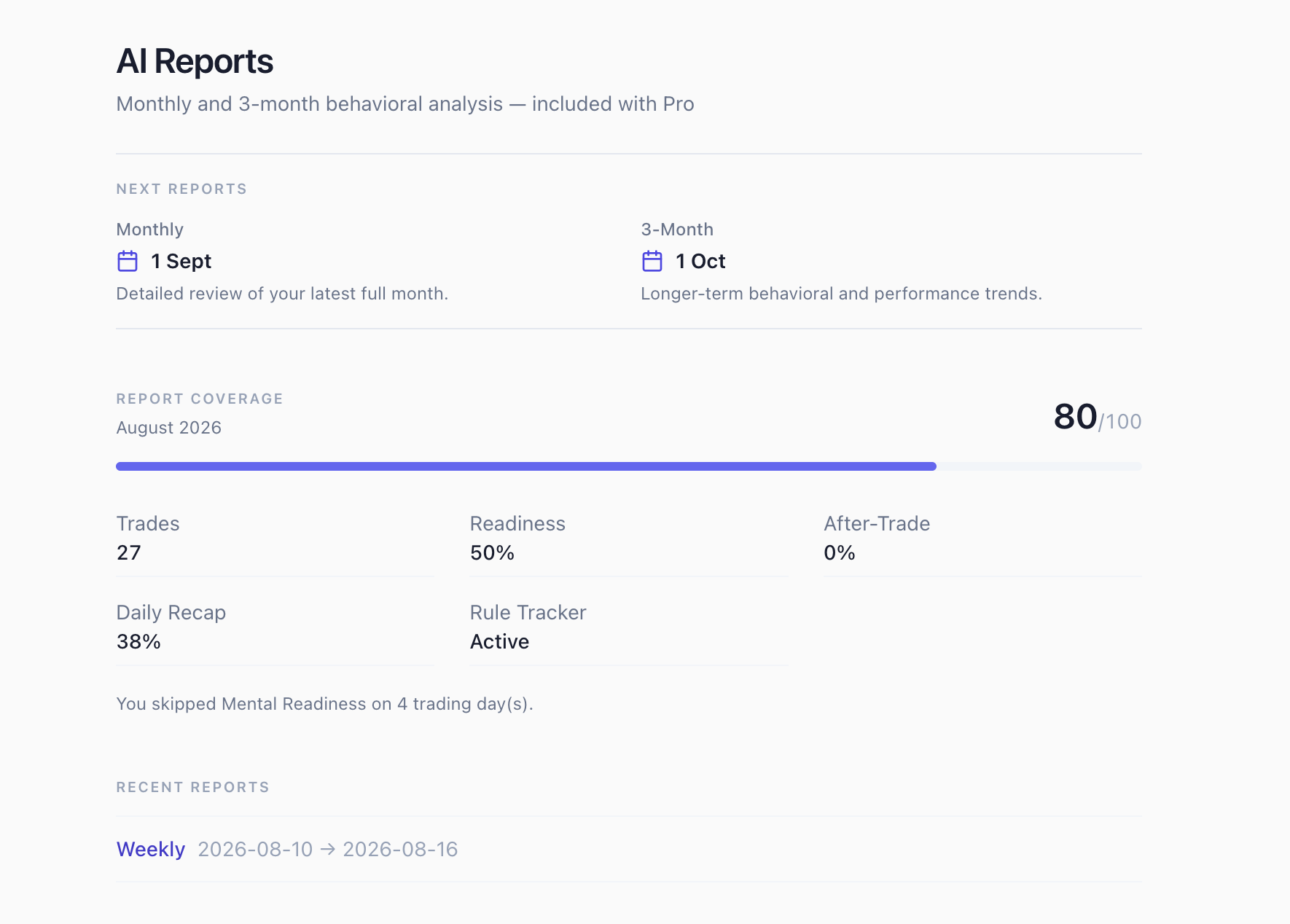
Monthly AI Reports
Generated automatically after each month closes, reviewing performance, psychology, discipline and execution.
3-Month AI Reports
A longer window that surfaces slower trends a single month cannot show.
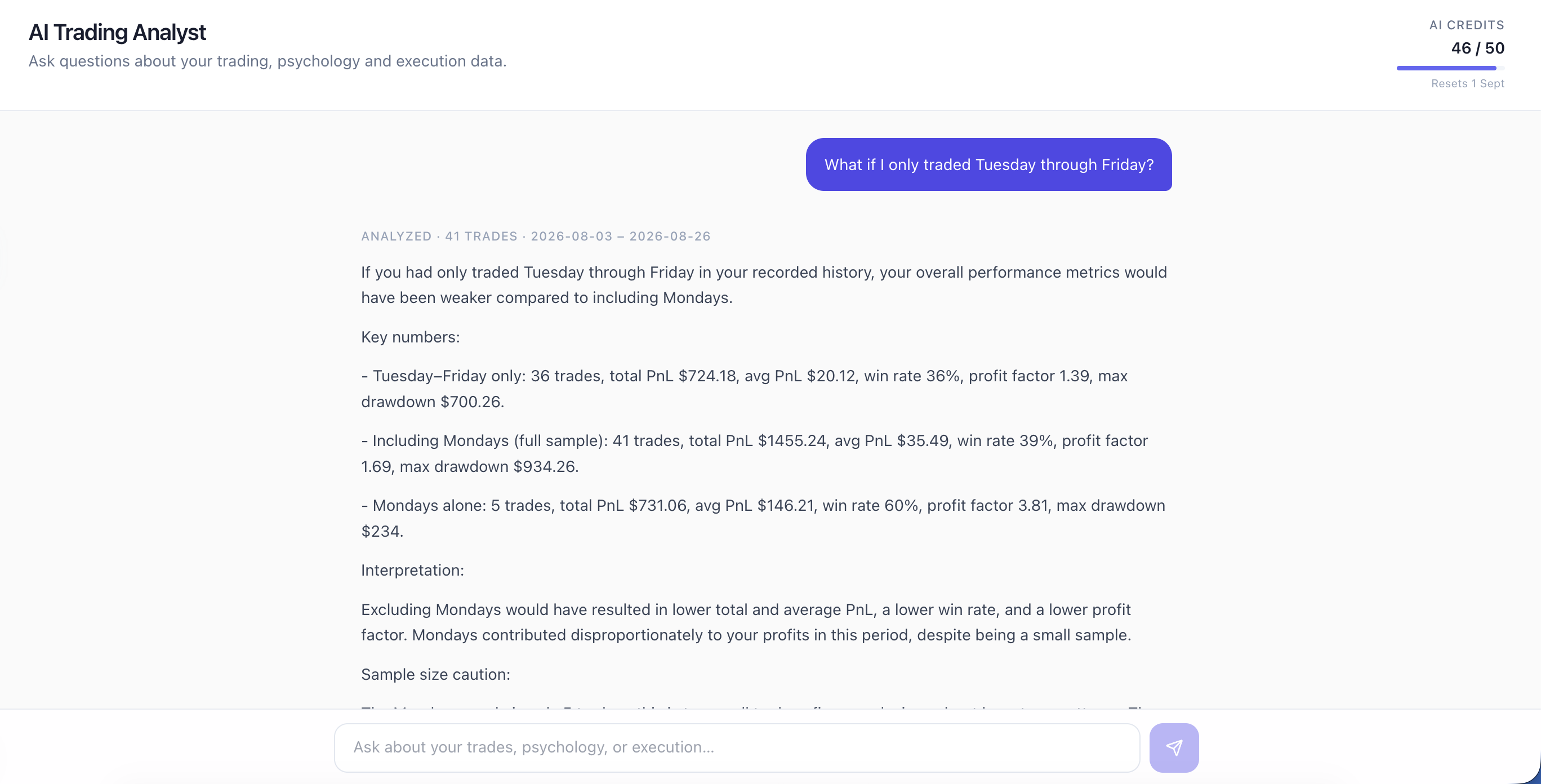
AI Trading Analyst
Ask questions about your own recorded data, including comparisons and historical what-if filtering.
Reference
What should a trading psychology journal track?
Useful whether or not you use MentalBro. Keep the fields short enough that you will actually fill them in every day — the same small set repeated is what makes a pattern readable months later.
Before the session
The conditions you bring to the screen. These are set before the first trade and shape everything after it.
Sleep and readiness
Hours slept and how rested you feel. Short sleep tends to show up as slower decisions and looser risk.
Emotional carryover
Whether yesterday's result is still with you. Carryover is where revenge sequences usually start.
Pressure to make money
Needing a green day is different from wanting one. Note when the session has a target attached to it.
Environment
Noise, interruptions, trading from a phone, other people in the room, unrelated stress.
Mental sharpness
How clear your thinking feels before the open, separate from how motivated you feel.
During the trade
Behavior while the position is live. This is the layer a normal journal almost never captures, because it is gone by the time you record the exit.
Rule compliance
Which of your own rules held and which bent — size, stop placement, trade count, session cutoff.
P&L fixation
Watching the open number rather than the chart. Usually precedes early exits.
Negative self-talk
The internal commentary during a drawdown. It predicts what you do next better than the drawdown does.
Urge to exit early
Wanting out before the thesis is invalidated or the target is hit.
Urge to move the stop
Whether you considered it, and whether you did it. Both are worth recording.
Overconfidence
Size creep and skipped checks after a run of winners.
Revenge behavior
Re-entering to recover a loss rather than because a setup appeared.
After the trade
Separating what happened from how well you traded it. Both matter, and they are not the same measurement.
Trade outcome
Entry, exit, instrument, size and result — the record every journal keeps.
Execution quality
Whether you followed the plan, scored independently of whether the trade paid.
Side by side
Standard trading journal vs psychology journal
The difference is not quality, it is scope. A psychology journal keeps everything a standard journal keeps and adds the behavioral layer on top.
A standard trading journal records
- Entry and exit
- Instrument
- Position size and P&L
- Setup or strategy tag
- Free-text notes
MentalBro also records
Everything on the left, plus:
- Pre-session mental readiness
- In-trade mindset check-ins
- Rule violations, counted
- Behavior patterns across sessions
- Psychology compared with performance
- Monthly and 3-month AI review
Fit
Who this is built for
MentalBro is most useful when you trade often enough for behavior to repeat, and when the gap you are trying to close is execution rather than strategy. It does not guarantee profitability.
Active day traders
Enough trades per week that behavioral patterns are measurable rather than anecdotal.
Futures traders
Leverage and session structure make readiness and cutoff rules expensive to ignore.
Prop-firm traders
Drawdown and consistency limits mean a single undisciplined session can end an account.
Traders with a tested strategy
You already know the edge works. The gap is between the plan and what you do at the screen.
What is a trading psychology journal?
It is a trading journal that records the conditions and behavior around a decision, not only the result. Alongside entry, exit and P&L, it captures things like pre-session readiness, emotional state, rule adherence and execution quality — so you can review why a trade was taken the way it was, not just how it finished.
What should I write in a trading psychology journal?
Record what you can answer honestly in a few seconds: sleep and readiness before the session, pressure or emotional carryover you brought with you, what happened to your rules during the trade, any urge to move a stop or exit early, and a separate score for execution quality after the trade. Consistency matters more than detail — the same fields every day is what makes patterns visible later.
How is a psychology journal different from a normal trading journal?
A normal journal answers what happened. A psychology journal also answers what state you were in and whether you followed your process. Two trades with identical results can represent completely different quality of execution, and only the second type of journal can tell them apart.
Can a trading journal help with revenge trading?
It can make the pattern visible, which is the part most traders are missing. Logging emotional carryover, rule breaks and re-entries after a loss shows how often the sequence repeats and what usually precedes it. A journal does not stop the behavior on its own — it gives you a record to review before the next session, and rules you can set in advance.
Can MentalBro import trades?
Yes, through CSV import. You upload a trading-history export from your platform and MentalBro turns it into journal entries. It is not a live broker connection — there is no automatic sync while you trade.
Does MentalBro automatically connect psychology with P&L?
Yes. Readiness scores, emotions, rule violations and execution notes are stored alongside your recorded trades, and the analytics compare them against performance. These are observed relationships in your own data, not proof that one caused the other.
Does MentalBro give trading signals?
No. MentalBro does not predict markets, recommend trades or generate strategy signals. It analyzes the data you have recorded about your own trading and behavior.
How does the AI Trading Analyst work?
You ask questions in plain language about your own recorded MentalBro data — for example how a particular weekday compares to the rest, or what your results look like above a given readiness threshold. It reads your journal, psychology logs and deterministic analytics. It does not access market data or make forecasts.
Start recording the part that repeats
Log your next session with readiness, rules and execution attached to it. After a few weeks there is enough to review.
7-day free trial, then $15/month. Cancel anytime from your account settings.